Discolouration & Staining
Teeth enamel discoloration can be caused by staining, tooth decay, aging, old amalgam fillings ,dietary and smoking habits which can damage the teeth. Some of the more common causes of teeth discoloration are medications, coffee, tea or cigarettes.
Aside from staining, there are other factors that can affect the color of an individual's teeth. Genetics can play a role. Some people have naturally brighter enamel than others. Disease can also be a factor and certain medications can cause a discoloration of the teeth.
Several Solutions depending on the underlying cause includes
- Cleaning/Polishing
- Bonding/Laminates
- Bleaching - Home
- In surgery
- Hybrid
- Veneers Inlays Crowns
Scaling and Polishing regularly by your dentist or hygienist helps keep your teeth and gums healthy and your smile whiter. Scaling removes the hard tartar which cannot be removed by brushing. Stains from coffee, tea, cigarettes or red wine are removed with the polishing. We provide sodium bicarbonate-based jet polishing on a private basis which is used for extremely stained or smokers teeth.
Bonding can mask many types of stains to create a natural-looking and attractive smile. However, bonded teeth tend to stain easily and require periodic repair. Bonding may be the best option if you:
- Have white or brown spots or staining due to excessive wear or silver fillings
- Are not a heavy smoker or coffee drinker
- Are willing to take extra care of your new smile
- Want a less expensive and less invasive option (compared with porcelain veneers or crowns)

- Although the average treatment time is about 4 to 6 weeks, you may notice results after just a few days.
- If you have decay, be sure to have your teeth treated prior to bleaching.
- Patients who are not good candidates for in office bleaching because of tooth sensitivity, time restrictions, or financial considerations can often be helped with home bleaching.
- For most patients, a combination of home and in office bleaching yields the best results.
- You may need a "touch-up" bleaching session every 6 to 12 months.
- Do not use any home bleaching product if you are pregnant or nursing a baby.
- Home bleaching can have adverse side effects, including tooth sensitivity, a burning sensation and sores on the gums and sore throat
| Polishing | Bleaching | Bonding | Porcelain Veneers | Crowns |
Treatment Time |
||||
Usually a 15- to 30- min appointment |
In office: 1-3 treatments as needed, about 30-90 min each Home: Daily for 1-12 mo, depending on stain severity |
1 office visit | 2 office visits, 1-4 hours each |
Usually 2 office visits of 1-4 hours each for up to 4 teeth (more time needed for additional teeth, esthetic temporaries, or more extensive treatment) |
Maintence |
||||
| Have a professional cleaning 4-6 times per year | Brush thoroughly after meals to remove plaque. |
Have a professional cleaning 3-4 times per year. |
Have a professional cleaning 3-4 times per year. |
Avoid biting down on hard foods and ice. |
Results |
||||
| Surface stains easily removed | Deep yellow stain can be considerably lightened; brown and gray stains are much more difficult to bleach. | Immediate masking of stains | Glazed, natural appearance and effective masking of stains. | Can achieve the best results in tooth shade, shape, and size. |
Treatment Longevity |
||||
| Usually 2-6 mo | Indefinite, although annual touch-ups may be required. | 3-8 years; may need repair or replacement more frequently | 5-12 years | 6-15 years (directly related to fracture, problems with tissues, and decay) |
Advantages |
||||
Least invasive procedure. |
Safe |
Painless |
Less chipping than bonding. |
Teeth can be lightened to any shade. |
Disadvantages |
||||
| May not remove stains enough to please you | Natural tooth color may not be restored. |
Can chip or stain. |
More expensive than bonding. |
Can fracture. |
Icon Treatment
We were recently contact by a representative from DMG regarding their product call Icon.
The product was originally developed for treating interproximal caries, (decay between the teeth to me and you)
however they noticed that is also had more of a cosmetic use as well.
Many people including myself have white spots on their teeth. Mine, I have no idea where it came from I’ve just always had it and was a bit of a clumsy child so just assumed it was trauma and there wasn’t much to be done about it unless I wanted a veneer or filling.
My tooth is healthy therefore drilling a healthy tooth seems somewhat wrong.
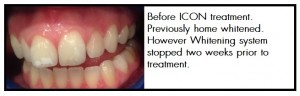
The cosmetic use is for vestibular treatment, therefore it can be applied directly to a white spot to change how light reflects on the defect therefore diminishing the appearance of the white spot. I basically wanted to try this to improve my white spot and considering mine was pretty large and very milky in colour, it made the rest of my teeth seem very yellow. Below is a photo of my front teeth prior to the treatment.
The procedure is as follows
- A mouth prop is placed to retract the soft tissues of the mouth, a rubber dam barrier between the tooth and the soft tissues is placed. This stops any of the products coming into contact with the soft tissues of the mouth.
- The Icon Etch is then placed on the tooth area and left for two minutes, until rinsed off and the tooth is dried, this process may be repeated 3-4 times depending on how deep the defect is within the tooth. Air abrasion may also be used to gain better access before etching. In my case air abrasion was used.
- Once the defective area is exposed the Icon dry is placed to see if the tooth has been etched enough. If the defect is non visible then it is time to place the Icon Infiltrant and to let set for 3 minutes. If not then the etch process may be repeated.
- Then the tooth is highly polished, additional composite material may need to be applied depending on how deep the defect was.
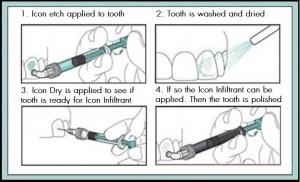
After this process which took around an hour including the polishing of the tooth surface. The results straight after the treatment are shown below.
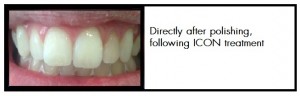
I was very pleased with this result, however the full effect of the product does not show until 2 weeks after, where it is recommended to give and secondary tooth surface polish. During this two week period it is not recommended to whiten the teeth as the product may take up staining.
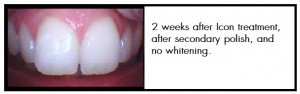
As you can see this is quite a dramatic change and did not require any filling material to smooth the surface.
This is a great result to book in for a consultation please call us on 01233 639289
Related Teeth Whitening Articles
The subconscious impact of a white smile is radiant health, happiness, warmth and invitation. This phenomenon has been reinforced with the spread of American culture worldwide, where an especially white smile has even been coined a "Hollywood smile." Today brighter, lighter, whiter teeth have become a norm. Tooth whitening by bleaching is a successful, conservative, relatively inexpensive and safe alternative... Read Article
.jpg "Teeth Whitening - Dear Doctor Magazine")
In Dear Doctor's interview with nationally noted teeth-whitening expert Dr. Van B. Haywood, he answers questions about bleaching techniques and safety in achieving the best possible results. If you are thinking about getting your teeth whitened at your dentist's office or doing it yourself at home, this is a must-read... Read Article
There have been no major health problems attributed to tooth whitening products when used as directed. Many studies have confirmed this, and we will share some of these findings with you...Read Article